AMX™Ammonia Removal by Tomorrow Water
The Most Resilient 2-Stage Anammox Solution
Pioneering new shortcuts in ammonia removal to municipal side-streams, mainstreams, livestock wastewater, food processing wastewater, landfill leachate, and industrial wastewater.
Two-Stage AMX™ ensures stable operation and rapid recovery
AMX technology utilizes short-cut nitrogen removal reactions that combines a partial nitritation (PN) reaction that converts half of ammonia into nitrite and an Anammox bacteria-enabled reaction that converts ammonia and nitrite into nitrogen gas. This technology is a next-generation water treatment solution that can reduce oxygen consumption and remove nitrogen from wastewater without an external carbon source.
Applications
Municipal Wastewater Treatment
Sludge dewatering centrate (Sidestream Treatment)
Mainstream Treatment
Securing Industrial Safety & Economy
Use in cases where economic feasibility does not materialize when treating low C/N ratio wastewater and if you need to consider energy independence
High-Concentration Liquid Waste Treatment
Treat high-concentration nitrogenous industrial wastewater streams and landfill leachate in the most economical way
Why nitrogen removal matters for Florida and Caribbean facilities
Florida's nutrient regulations are getting stricter, not looser
Caribbean utilities face the same nitrogen problem with less existing infrastructure
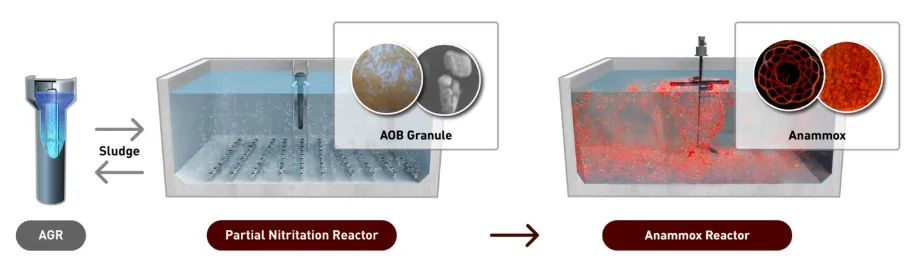
Partial Nitration Reactor
Partial Nitritation using dense ammonia oxidizing bacteria (AOB) granules.
- Operation with high MLSS(6,000 ~ 8,000 mg/L) inside the reactor
- Short settling time of 20 minutes(SVI less than 30)
- Maximizing partial nitritation efficiency with aerobic conditions
Anammox Reactor
Anammox reaction with dense anammox microorganisms attached to moving bed media.
- Securing high density anammox microorganisms in the reactor
- Maximizing anammox reaction efficiency with anaerobic conditions
| Site | Application | Country | Capacity | Status |
|---|---|---|---|---|
| Noksan STP (Busan) | Side-stream (digester centrate) | Korea | 780 m³/d | Operating (2023) |
| Daejon STP (old plant) | Side-stream (digester centrate) | Korea | 600 m³/d | Operating (2018) |
| Daejon STP (new plant) | Side-stream (digester centrate) | Korea | 1,440 m³/d | Under construction (2028) |
| Gangbyeon STP (Busan) | Side-stream (digester centrate) | Korea | 70 m³/d | Completed (Anammox farm for Noksan) |
| Daegu City STP | Side-stream (codigestion) | Korea | 30 m³/d | Operated (2021-2022) |
| Hongcheon | Livestock / food waste digestate | Korea | 2.6 m³/d | Completed pilot plant |
| Muan City | Food waste | Korea | 90 m³/d | In design (2026) |
| Goesan City | Food waste | Korea | 280 m³/d | In design (2026) |
| Sudokwon Landfill (Incheon) | Landfill leachate | Korea | 2 m³/d | Completed pilot plant (2020) |
| JWPCP | Main-stream | USA | 40 m³/d | Completed demo plant (2015) |
| Hyperion Water Reclamation Plant (California) | Main-stream | USA | 40 m³/d | Completed demo plant (2022) |
| Hyperion Water Reclamation Plant (California) | Side-stream (digester centrate) | USA | 1 m³/d | Completed demo plant (2021) |
| Bos Dairy Farm (Indiana) | Livestock digestate | USA | 1 m³/d | Completed demo plant (2018) |
The AMX
Advantage
Highest Nitrogen Removal
Rate in the Market
─────────────────────
Most Resilient to Upsets:
TSS, COD, & Ammonia Spikes,
NOB Growth
─────────────────────
Quick Start-up, restart, and
recovery of AOB communities
─────────────────────
AMX vs. ANITA Mox vs. DEMON: how the leading anammox technologies compare
Municipal and industrial engineers evaluating deammonification typically shortlist three commercially proven anammox platforms. Here's how AMX's two-stage process stacks up against the market's single-stage alternatives.
| Factor | AMX (Carver Water Technology) | ANITA Mox (Veolia) | DEMON (World Water Works) |
|---|---|---|---|
| Process configuration | Two-stage: independent partial nitritation (PN) reactor and Anammox reactor, isolating each population | Single-stage MBBR or IFAS, both reactions in one tank | Single-stage granular sludge, SBR or continuous flow |
| Total nitrogen removal | 89.8% demonstrated at full scale (Hongcheon, Korea) | 75-85% total nitrogen removal, over 90% ammonia removal | Publishes loading rate performance (up to 1.4 kg N/m³/day); TN removal not separately published |
| Aeration energy | Reduces nitrification aeration requirements by two-thirds; 53% aeration energy reduction demonstrated at Hongcheon | Markets itself as low energy cost vs. conventional nitrification-denitrification; specific figures not independently published | Cites conventional nitrification-denitrification as requiring 1.8-2.7 kW-hr/lb nitrogen removed, positions DEMON below that baseline |
| Carbon source required | None. 100% elimination of external carbon dosing cost vs. conventional denitrification | None | None |
| Sludge production | Up to 90% less sludge than conventional processes; 80% reduction in sludge volume demonstrated at Hongcheon | Not separately published | Not separately published |
| Footprint | No secondary clarifier required post-treatment, eliminating a major footprint driver | Compact media-based platform, footprint scales with media volume | Granular system, footprint tied to reactor and separation equipment sizing |
| Resilience to upsets | Two-stage isolation protects the Anammox population from organic matter and suspended solids in the influent; proven on high COD, high TSS, low alkalinity streams (Hongcheon livestock digestate) | Single-tank design; media platform is widely cited in industry literature as robust and forgiving to operate | Granule washout was a historical limitation with hydrocyclone separation; addressed by a micro-screen upgrade retaining over 95% of anammox biomass |
| Salinity tolerance | Anammox strain tolerates salinity up to 3%, roughly 2x higher growth rate than competing strains under saline conditions | Not published | Not published |
| Applications | Sidestream, mainstream, landfill leachate, livestock digestate, food processing wastewater, industrial nitrogen streams | Primarily sidestream, with mainstream applications on select installations | Primarily sidestream dewatering reject flows |
| Pilot testing before full-scale commitment | Fully containerized, transportable pilot unit available to confirm performance on your actual wastewater before capital commitment | Not publicly detailed | Not publicly detailed |
| Regional installation and support | Direct engineering, service, and parts support across the Southeast US and Caribbean through Carver Water Technology | Larger installed base, primarily served through Veolia's national network | Larger US installation count, served through WWW's national network |
Figures for AMX are drawn from Tomorrow Water's published pilot and full-scale performance data. Figures for ANITA Mox and DEMON are drawn from each vendor's publicly available technical literature. Actual performance for any of these platforms depends on site-specific flow, temperature, and loading conditions, confirm sizing with a pilot or engineering evaluation before final selection.
Schedule a technical consultation to get an AMX evaluation sized to your facility's ammonia loading and flow conditions.
READY TO GIVE US A TRY?
Interested in AMX?
AMX ammonia removal: frequently asked questions
What is Anammox ammonia removal?
Anammox (anaerobic ammonium oxidation) is a biological process that converts ammonia directly to nitrogen gas using naturally occurring bacteria, without the aeration energy or external carbon dosing required by conventional nitrification-denitrification. AMX applies this through a two-stage design: a partial nitritation reactor converts roughly half the ammonia to nitrite, then a separate Anammox reactor converts the remaining ammonia and nitrite to nitrogen gas.
How is AMX different from conventional nitrification-denitrification?
Conventional treatment requires heavy aeration to nitrify ammonia to nitrate, then an external carbon source to denitrify it back to nitrogen gas. AMX skips the carbon addition step entirely and uses less oxygen, which lowers both chemical and energy operating costs for facilities handling high-strength ammonia streams like digester centrate or landfill leachate.
What is sidestream vs. mainstream treatment?
Sidestream treatment targets the small-volume, high-ammonia-concentration stream produced by dewatering digested sludge, before it's returned to the head of the plant. Mainstream treatment applies Anammox directly to the plant's primary wastewater flow. Sidestream is the more established application; AMX has demonstrated installations in both.
What industries and waste streams is AMX suited for?
AMX is engineered for municipal wastewater sidestream and mainstream treatment, high-concentration industrial nitrogen streams, landfill leachate, livestock digestate, and food and beverage processing wastewater, anywhere ammonia loading is too high or too costly to treat economically with conventional biological nitrogen removal.
How long does an Anammox system take to start up?
Anammox bacteria are slow-growing, which historically made startup and recovery from an upset a multi-month process for early deammonification systems. AMX's two-stage design is built for faster startup, restart, and recovery of the ammonia-oxidizing bacteria community. Actual timelines depend on seed biomass availability, flow conditions, and site-specific ammonia loading. Carver Water Technology can size a startup plan against your facility's numbers.
Does Carver Water Technology install and service AMX systems directly?
Yes. Carver Water Technology is the authorized Southeast US and Caribbean partner for Tomorrow Water's AMX, DRACO, and Proteus technologies, handling system design, installation, and ongoing plant operations and maintenance for municipal, industrial, and Caribbean clients.

Innovation
Fresh, creative solutions.

Integrity
Honesty and transparency.

Excellence
Top-notch services.

FOLLOW US


TECHNOLOGY & SERVICES
ABOUT US
CUSTOMER CARE
LEGAL
Copyright 2026. Carver Water . All Rights Reserved.